
Why Cheap Web Design Usually Cost More in the Long Run
A low-cost website can look like a smart investment when you’re trying to control your marketing budget. A quick template, a few pages, and a low upfront price may seem like everything your business needs to establish an online presence.
But a website is more than a digital business card.
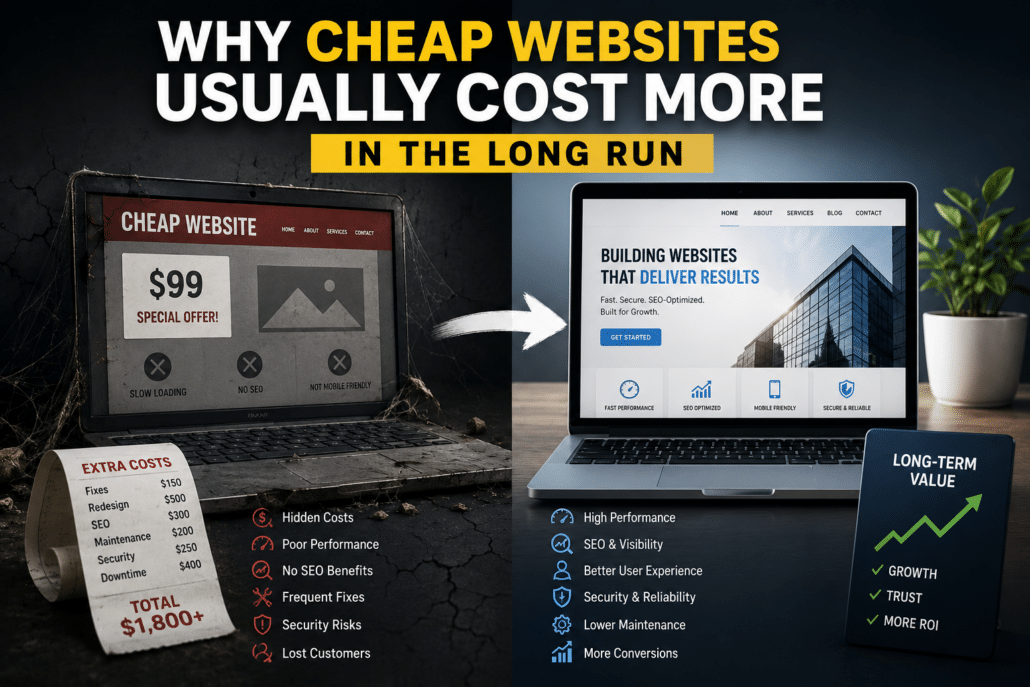
When the foundation is weak, the real costs often appear later through slow performance, security problems, poor mobile usability, weak search visibility, difficult maintenance, and missed leads. What seemed inexpensive at launch can become significantly more expensive once you begin paying for repairs, redesigns, advertising, and lost opportunities.
At Hyland Graphic Design & Advertising, we regularly see businesses discover this after their website has already become a problem. Strategic Web Design and professional Website Development can help prevent those issues before they become expensive.
What Most Businesses Misunderstand About Cheap Websites
The biggest misconception is that all websites essentially do the same thing.
A business owner may compare two websites and think, “They both have a homepage, services page, contact page, and photos. Why should one cost more?”
The difference is what happens underneath the design.
A professional website considers the customer journey, page structure, mobile experience, search visibility, content organization, security, performance, analytics, and future growth.
A cheap website may simply assemble a collection of prebuilt elements.
Templates aren’t automatically bad. The problem occurs when a business chooses a platform based entirely on the lowest possible price without considering how that platform will perform as the company grows.
A website that cannot support your marketing goals eventually becomes a limitation rather than an asset.
The Real Costs Often Appear After Launch
The initial price of a website is only one part of its total cost.
A low-cost website may eventually require additional spending because of:
- Repeated technical repairs
- Plugin conflicts
- Slow page performance
- Security updates
- Mobile layout problems
- Redesigns
- Search engine optimization fixes
- Poor conversion performance
- Lost customer inquiries
- Additional advertising to compensate for weak organic visibility
This is why businesses should evaluate a website based on its long-term value rather than simply its launch price.
A website that costs more initially but generates consistent leads and requires less maintenance may ultimately be the more affordable option.

What Hyland Graphics Sees During Website Audits
At Hyland Graphic Design & Advertising, we often encounter websites that appear acceptable at first glance but have significant problems beneath the surface.
Two patterns appear particularly often.
The Bloated Website Problem
A small business may start with a simple template and gradually add functionality.
One plugin handles forms.
Another adds sliders.
Another handles pop-ups.
Another manages security.
Another adds tracking.
Eventually, the website becomes dependent on numerous third-party tools that may conflict with one another.
The result can be slower performance, more maintenance, unexpected errors, and a greater risk that an update will break an important part of the website.
Professional Website Development takes a more strategic approach by considering which features are actually necessary and how they should work together.
The Silent Lead Problem
Some businesses have plenty of website traffic but very few inquiries.
The problem isn’t always marketing.
Sometimes the website itself is preventing conversions.
A contact button may be difficult to find. A form may not work properly on mobile. The phone number may be hidden. The service information may be unclear. Or the page may give visitors no obvious reason to take the next step.
A visually attractive website can still lose leads if the customer journey isn’t designed properly.
That is where strategic Web Design makes a difference.
Why Cheap Websites Can Hurt Your Marketing Investment
Your website is connected to nearly every other marketing activity your business uses.
If you’re running Google Ads, social media campaigns, email marketing, or search engine optimization, much of that traffic eventually reaches your website.
If the website doesn’t perform, your other marketing investments become less effective.
Poor Conversion Strategy
A website should guide visitors toward meaningful actions.
Depending on your business, that may mean requesting a quote, calling your office, booking an appointment, purchasing a product, or submitting a consultation request.
Cheap websites frequently focus on assembling pages rather than creating intentional conversion paths.
The result is a website that provides information but doesn’t effectively turn attention into action.
Weak Mobile Experience
Customers increasingly interact with businesses through smartphones.
If text is difficult to read, buttons are too small, forms don’t work, or navigation becomes confusing on a mobile screen, visitors may simply leave.
Mobile responsiveness should be part of the initial Web Design strategy, not something added after launch.
Slow Performance
Large images, unnecessary scripts, excessive plugins, inefficient code, and poor hosting can all contribute to slow websites.
A slow website creates frustration and can affect both user experience and search performance.
Rather than repeatedly trying to repair performance problems after launch, professional Website Development plans for efficient performance from the beginning.
Security and Maintenance Problems
Every website needs ongoing attention.
Software updates, security monitoring, backups, compatibility checks, and content updates are part of responsible website ownership.
A low-cost website that depends on numerous third-party components can become difficult to maintain.
When one component stops receiving updates or conflicts with another, the business may have to pay for emergency repairs.
Web Design Should Support the Business, Not Just the Brand
Good Web Design should look professional, but appearance is only one part of the equation.
Your website should also answer important questions quickly.
What does the business do?
Who does it serve?
Where does it operate?
Why should customers choose it?
What should visitors do next?
When those answers are easy to find, visitors don’t have to work to understand your business.
Clear messaging, professional branding, intuitive navigation, strong calls-to-action, authentic imagery, and strategic page layouts create a better customer experience.
That is the difference between designing a website and designing a business tool.
A Practical Website Quality Check
You don’t necessarily need to rebuild your website immediately.
Start by evaluating what you already have.
Test the Mobile Experience
Open your website on several smartphones.
Check every menu, button, form, image, and important page. Make sure nothing overlaps and that visitors can complete your primary conversion action without frustration.
Test Your Lead Flow
Submit your own contact form.
Does the form work?
Does the submission reach the correct inbox?
Does the customer receive an appropriate confirmation?
A broken form can quietly cost your business leads every day.
Review Your Page Speed
Test your website using a reliable performance-testing tool and examine the issues affecting loading speed.
Large images, unnecessary scripts, and excessive plugins are common areas worth investigating.
Review Your Website Content
Read your homepage as though you’ve never heard of your company.
Can you understand the business within a few seconds?
Are your services clear?
Is your service area obvious?
Can visitors immediately find a phone number or contact option?
If not, the problem may be strategic rather than cosmetic.
Check Your Brand Consistency
Your website should feel like the same business customers encounter in your advertisements, printed materials, social media, and other marketing channels.
Consistent colors, typography, photography, messaging, and branding create a more professional experience.
Common Mistakes Businesses Should Avoid
Choosing the Lowest Price Without Considering Value
The cheapest proposal isn’t necessarily the least expensive solution.
Compare what each provider includes, how the website will be maintained, how the platform can grow, and whether the design is built around your actual business objectives.
Treating Website Content as an Afterthought
Design and content should work together.
If the website is designed first and the copy is added later, important messaging and conversion elements may never fit naturally into the layout.
Ignoring Future Growth
Your business may add services, locations, employees, booking systems, e-commerce functionality, or new marketing campaigns.
A website should have enough flexibility to accommodate growth.
Building a Website Without Analytics
Without proper analytics and conversion tracking, you have limited visibility into how visitors interact with your website.
You should be able to understand which pages attract attention, where users leave, and which actions generate inquiries.
Forgetting Ongoing Maintenance
Launching a website doesn’t mean the project is finished forever.
Technology changes. Search behavior changes. Customer expectations change.
Regular maintenance helps keep your website secure, functional, current, and competitive.
Why Professional Website Development Can Save Money
Professional Website Development is not simply about writing code.
It is about creating a reliable foundation for your digital presence.
A strategic development process considers the website’s structure, performance, functionality, integrations, security, content management, mobile experience, and long-term maintenance.
When those decisions are made correctly at the beginning, businesses are less likely to spend years paying for temporary fixes.
That can make the initial investment more valuable over time.

The Role of a Digital Marketing Company
A website shouldn’t exist separately from your marketing strategy.
When your website, branding, search engine optimization, advertising, content, and conversion strategy are managed independently, important opportunities can be missed.
Working with an experienced digital marketing company can bring those pieces together.
At Hyland Graphic Design & Advertising, we approach digital marketing from both the creative and strategic sides. The website needs to represent the brand professionally while also supporting measurable business goals.
That means asking bigger questions:
Is the website attracting the right audience?
Does the messaging match what customers are searching for?
Are visitors finding the information they need?
Are they taking action?
Is the website helping the rest of the marketing strategy perform better?
Those questions matter far more than simply asking how quickly a website can be launched.
Final Recommendation
A cheap website isn’t always a bad website.
But choosing a website based entirely on its low upfront price can create problems that become much more expensive later.
Poor performance, weak conversion paths, security concerns, difficult maintenance, inconsistent branding, and limited scalability can turn a seemingly affordable website into a long-term expense.
Your website should be an investment in your business—not a recurring source of problems.
At Hyland Graphic Design & Advertising, we build websites around business goals, customer behavior, brand identity, performance, and long-term growth. Our approach to Web Design combines creative execution with strategic thinking so your website can become a stronger part of your overall marketing system.
Is your current website helping your business grow—or costing you customers?
If your website looks acceptable but isn’t generating the results you expect, a professional review can help identify where the problems are coming from.
Build a Better Website with Hyland Graphic Design & Advertising.
Frequently Asked Questions
What makes professional Web Design worth the higher initial investment?
Professional Web Design considers much more than appearance. Hyland Graphic Design & Advertising develops websites around user experience, conversion paths, brand consistency, mobile performance, and long-term business goals. A strategic website can reduce ongoing repair costs while creating a stronger platform for generating qualified leads.
How can a cheap website hurt a business’s online visibility?
Low-cost websites may use bloated templates, unnecessary plugins, inefficient code, or weak mobile layouts that can create performance and usability problems. Hyland Graphic Design & Advertising focuses on building technically sound websites that support a stronger user experience and provide a solid foundation for search engine optimization.
Can a digital marketing company improve an existing low-cost website?
Yes. A digital marketing company can evaluate an existing website and identify problems involving design, content, conversion opportunities, performance, and marketing strategy. Hyland Graphic Design & Advertising can recommend targeted improvements when a website is worth preserving or determine when rebuilding the platform is a more practical long-term solution.
Why does Website Development matter when choosing a website provider?
Website Development determines how well the platform functions beneath the visual design. Hyland Graphic Design & Advertising considers performance, responsive behavior, security, integrations, functionality, and scalability when developing websites. A strong technical foundation makes the website easier to maintain and adapt as the business grows.
How often should a business update its website?
There is no universal replacement schedule because every business and website is different. Content, services, branding, technology, and customer expectations should be reviewed regularly. Hyland Graphic Design & Advertising recommends monitoring website performance and making strategic improvements as business goals and customer behavior evolve rather than waiting until the website becomes outdated.
Is a template website always a bad choice?
No. A template can work for certain businesses when it is properly configured, maintained, optimized, and customized. The problem is choosing a template solely because it is cheap and then expecting it to support complex marketing, functionality, and growth requirements. Hyland Graphic Design & Advertising evaluates the business goals first and then recommends the appropriate Web Design and development approach.


