
How Inconsistent Branding Hurts Customer Trust
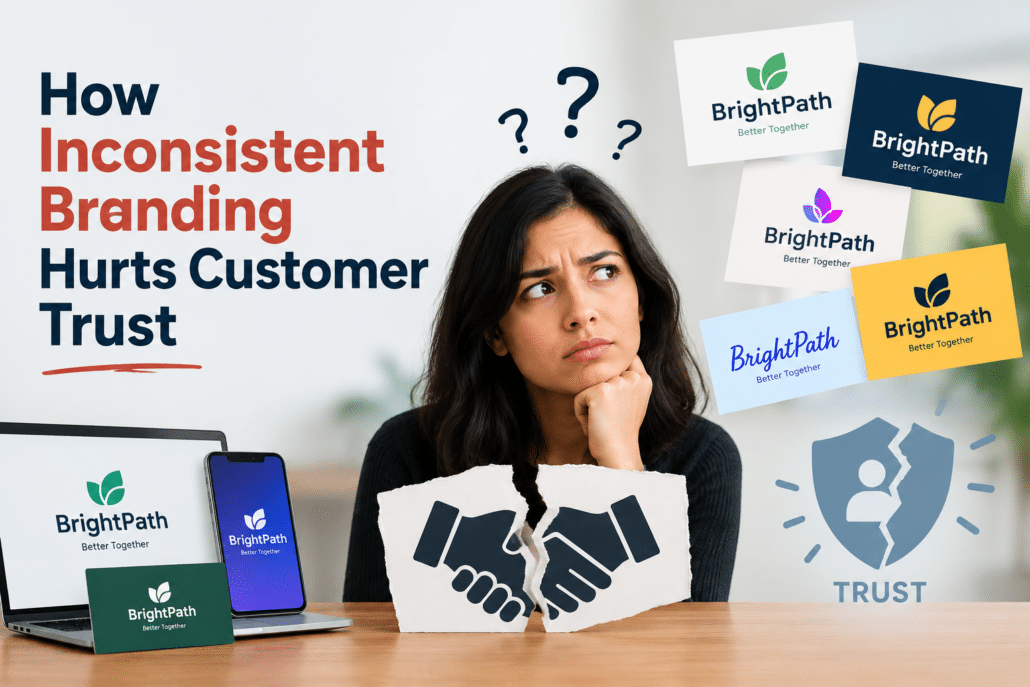
Customers begin forming opinions about a business long before they speak with a sales representative. Your website, social media profiles, advertisements, proposals, business cards, signage, packaging, and other marketing materials all contribute to that impression. When those touchpoints look disconnected, customers may become uncertain about what your company represents. A professional branding agency Philadelphia businesses rely on can help create a consistent visual identity that communicates credibility across every customer interaction.
Consider a company using one logo on its website, another on social media, outdated colors on its sales proposals, and completely different messaging in its advertisements. Each inconsistency may seem minor, but together they can make the business appear less organized than it actually is.
At Hyland Graphic Design & Advertising, we help businesses create structured visual systems that keep their marketing materials aligned across different channels. Effective branding gives companies a consistent way to communicate who they are, what they offer, and what customers can expect.
This article explores how inconsistent branding can affect customer confidence, where businesses commonly lose visual consistency, and practical steps you can take to create a more unified brand experience.
Why Consistency Matters in Branding
Customers rarely interact with a business through just one channel.
A potential customer may discover your company through Google, visit your website, look at your social media profiles, receive a sales proposal, read an email, and eventually visit your physical location. Each interaction contributes to their overall perception of your organization.
When these touchpoints share the same core identity, customers can recognize your business more easily. Your logo, colors, typography, photography, messaging, and design elements work together to create familiarity.
Consistency does not mean every marketing asset needs to look exactly the same. Instead, it means there should be a recognizable connection between the different ways your business presents itself.
A social media post can have a different layout from a brochure. A sales presentation can have a different structure from a website page. What matters is that customers can still recognize the same organization behind each communication.
What Businesses Often Get Wrong About Visual Consistency
One common misconception is that customers do not notice small design differences.
A business might use its current logo on its website but an older version on Facebook. Its invoices may use different colors, while its sales presentations use another font. Its advertisements may follow an entirely different visual style.
Individually, these differences may appear insignificant.
Collectively, however, they can make the company feel disconnected.
Another misconception is that brand consistency means placing the same logo and colors everywhere without considering context.
A successful brand system needs flexibility. It should work across websites, social media, print materials, advertisements, presentations, signage, email communications, and other formats while maintaining recognizable characteristics.
This is an important part of working with a brand building agency Philadelphia businesses can rely on: the goal is not to make every communication identical, but to establish a system that keeps the brand recognizable wherever customers encounter it.
How Inconsistent Branding Can Create Customer Doubt
Customers often use visual information as one of many signals when evaluating a company.
Imagine a potential client comparing two businesses for an important project.
The first company has a modern website, professional proposal, consistent social media graphics, and a recognizable visual identity.
The second company has an outdated website, an older logo on its proposal, several different color schemes, and marketing materials created at different times without a unified design system.
The actual quality of the two businesses could be completely different from what their marketing suggests. However, inconsistent presentation can create additional uncertainty.
A potential customer might wonder:
- Is this the same company?
- Are these materials current?
- Which logo or information is accurate?
- Does the company pay attention to details?
- Will the customer experience be equally inconsistent?
- Is this business established enough to handle my project?
Visual presentation cannot guarantee a purchase or establish trust by itself. However, a fragmented presentation can introduce unnecessary friction into the decision-making process.
What Hyland Graphic Design & Advertising Sees in Client Branding
During creative and marketing reviews, Hyland Graphic Design & Advertising often encounters businesses that have invested in individual marketing assets without developing a consistent system connecting them.
For example, a company may have a modern website but continue using an older logo and outdated proposal templates. Another business may have professional vehicle graphics while its social media profiles use unrelated colors and design styles.
These disconnected elements can make a company appear less established than it actually is.
In situations like these, redesigning one individual asset may not solve the underlying problem.
The better approach is to evaluate the complete customer-facing experience and identify where inconsistencies occur.
A unified visual system can then be developed across important touchpoints such as:
- Website graphics
- Sales presentations
- Quote and proposal documents
- Social media templates
- Digital advertisements
- Email signatures
- Business cards
- Print materials
- Vehicle graphics
- Promotional materials
The larger lesson is simple: your brand does not stop at your website. Every customer-facing communication contributes to how people recognize and understand your business.
Your Brand Is More Than Your Logo
A logo is an important part of a brand identity, but it is only one component of the overall system.
A complete visual identity can include:
- Logo variations
- Brand colors
- Typography
- Photography style
- Graphic elements
- Iconography
- Tone of voice
- Messaging
- Advertising layouts
- Social media templates
- Presentation templates
- Email signatures
- Printed materials
- Packaging and signage
When these elements work together, customers can more easily recognize your organization across different environments.
This is where structured brand building agency Philadelphia services can be useful. Instead of designing individual materials whenever a new need appears, businesses can establish a framework that guides future marketing decisions.
How Brand Inconsistency Can Affect the Customer Journey
Visual inconsistency can become particularly noticeable when customers move from one stage of the buying journey to another.
For example, a prospect might discover your business through a polished advertisement.
They click through to your website and encounter a completely different visual identity.
Later, they receive a proposal using another logo and a different set of colors.
Each transition creates another opportunity for confusion.
A professional branding agency Philadelphia businesses work with can help identify these gaps and establish practical standards for maintaining consistency across marketing materials.
The goal is to create a familiar experience from the customer’s first interaction through the sales process and beyond.
Build a Centralized Brand System
One of the simplest ways to improve consistency is to establish a centralized location for approved brand assets.
Your team should know exactly where to find:
- Current logo files
- Approved color codes
- Official fonts
- Brand guidelines
- Social media templates
- Presentation templates
- Email signature formats
- Approved photography
- Advertising assets
- Approved messaging
Without a centralized system, employees may use files stored on personal computers or old attachments from previous projects.
That is how outdated materials continue appearing in customer communications.
A centralized asset library gives employees access to the same approved resources and reduces the possibility of accidentally using outdated files.
Practical Action Plan for Improving Brand Consistency
Audit Your Current Marketing Materials
Review your website, social media profiles, advertisements, proposals, business cards, brochures, signage, email signatures, presentations, and other customer-facing materials.
Look for:
- Outdated logos
- Inconsistent colors
- Different fonts
- Conflicting messaging
- Old templates
- Inconsistent photography
- Unrelated design styles
The goal is to understand where the current identity is consistent and where it has become fragmented.
Remove Outdated Assets
Once your updated brand standards are established, remove older versions from shared folders and team resources whenever possible.
Keeping outdated files easily accessible increases the chance that someone will accidentally use them again.
Create Practical Brand Guidelines
Your team does not necessarily need a 100-page brand manual.
A practical brand guide can explain:
- Logo usage
- Brand colors
- Typography
- Imagery
- Design elements
- Messaging style
- Social media standards
- Basic layout rules
The document should be easy for employees and external partners to understand and use.
Standardize Sales Materials
Sales teams regularly communicate directly with potential customers, making their materials particularly important.
Provide approved templates for:
- Proposals
- Presentations
- Quotes
- Case studies
- Email signatures
- Follow-up documents
Standardized materials help ensure customers receive a consistent experience regardless of which member of the sales team they communicate with.
Review Your Brand Regularly
Businesses evolve.
New services are introduced, target audiences change, companies expand into new markets, and new marketing channels emerge.
Review your brand materials periodically to ensure they still accurately represent your business and remain consistent across customer touchpoints.
Common Branding Mistakes to Avoid
Allowing Employees to Modify Logos
Changing logo proportions, colors, fonts, or other elements may seem harmless, but repeated modifications can weaken recognition.
Keep approved logo files available and provide clear instructions for their use.
Using Different Colors for Every Campaign
Campaigns can have their own creative direction, but they should still connect to the company’s core visual identity.
A campaign that looks completely unrelated to your business can make it harder for customers to recognize the source.
Mixing Too Many Fonts
Typography contributes significantly to visual consistency.
Choose a limited group of approved fonts and establish where each should be used.
Keeping Old Marketing Materials in Circulation
Even after a redesign, outdated brochures, proposal templates, advertisements, and social graphics can continue appearing if they are not replaced.
Create a transition plan when updating your visual identity and communicate the changes clearly to your team.
Treating Social Media as Separate From the Brand
Social media is part of your overall customer experience.
The visual style used on social platforms should connect naturally with your website, advertising, print materials, and other customer-facing channels.
Does Consistent Branding Help Build Customer Trust?
Consistency can make a business easier to recognize and contribute to a more cohesive customer experience.
When customers see the same core identity across multiple interactions, they receive a clearer picture of who the company is and what it represents.
This can be particularly useful for businesses with longer sales cycles or higher-value services, where customers may interact with a company several times before making a decision.
However, branding should not be viewed as a substitute for good products, reliable service, transparent communication, or strong customer experiences.
The goal is to make every interaction feel like it comes from the same established organization.
How a Branding Agency Can Help
Maintaining consistency becomes more difficult as a business grows.
Different employees create different materials. New marketing channels are introduced. Sales teams develop their own documents. New campaigns require fresh graphics. Multiple vendors may also produce marketing materials independently.
Without clear standards, a company’s identity can gradually become fragmented.
A professional branding partner can help businesses:
- Audit existing materials
- Identify visual inconsistencies
- Establish brand standards
- Develop templates
- Organize brand assets
- Create visual guidelines
- Standardize customer-facing materials
- Support future marketing campaigns
This creates a foundation for future marketing rather than requiring the business to start from scratch every time a new asset is needed.
A Simple Brand Consistency Checklist
Logo
- Are you using one approved logo system?
- Have outdated versions been removed?
- Are employees using the correct logo variations?
Colors
- Are your primary and secondary colors clearly defined?
- Are the correct color codes available to your team?
- Are colors being used consistently?
Typography
- Are approved fonts being used across marketing materials?
- Do proposals and presentations follow the same typography system?
Imagery
- Does your photography have a consistent visual style?
- Do your graphics feel like they belong to the same company?
Messaging
- Does your website communicate the same core message as your sales materials?
- Is your tone consistent across different channels?
Sales Materials
- Are proposal and presentation templates standardized?
- Do team members have access to current versions?
Digital Channels
- Does your social media presentation connect with your website?
- Are your online profiles using current brand assets?
Print and Physical Materials
- Do business cards, brochures, signage, and vehicle graphics follow the same identity?
- Have outdated materials been replaced?
Protect the Trust You Have Worked to Build
Your business may provide excellent products or services, but customers do not directly experience your internal operations. They experience what you show them.
Your website, social media profiles, proposals, advertisements, presentations, and other communications become part of the evidence customers use to understand your company.
When those elements are coordinated, your business presents a clearer and more recognizable identity. When they are inconsistent, customers may spend more time questioning the presentation instead of focusing on your services.
At Hyland Graphic Design & Advertising, we help businesses develop cohesive visual systems that support their marketing goals and create a more consistent customer experience.
If inconsistent branding is making your business look less established than it really is, a professional brand audit can help identify where the gaps exist and what should be standardized.
Schedule a brand consistency consultation with Hyland Graphic Design & Advertising to review your current presentation and identify opportunities for a stronger, more cohesive customer experience.
FAQs
How does branding affect customer trust?
Consistent branding helps customers recognize a business and creates a more unified experience across different interactions. Hyland Graphic Design & Advertising helps businesses align their visual identity across websites, social media, advertising, sales materials, and other customer-facing channels.
What are the most common signs of inconsistent branding?
Common signs include multiple versions of a logo, inconsistent colors, different fonts, outdated sales documents, conflicting messaging, and social media graphics that do not match the company’s website. Hyland Graphics can review these touchpoints to identify areas where the brand has become fragmented.
Why is a brand building agency Philadelphia businesses can use important for growing companies?
A structured brand-building process gives growing companies practical guidelines for maintaining a recognizable identity as new employees, marketing channels, and promotional materials are introduced. Hyland Graphic Design & Advertising can help establish visual standards and reusable templates that make consistency easier to maintain.
How often should a business review its brand materials?
Businesses should review their customer-facing brand materials periodically, especially when introducing new services, redesigning a website, expanding into new markets, or experiencing significant growth. Hyland Graphics can help businesses identify outdated assets and determine which materials need to be updated.
Should every marketing campaign use exactly the same design?
Not necessarily. Campaigns can have their own creative concepts while still maintaining recognizable connections to the company’s core identity. Hyland Graphic Design & Advertising can develop flexible brand systems that allow creative campaigns while maintaining important visual standards.
When should I work with a branding agency Philadelphia businesses can rely on?
A business may consider working with a branding agency Philadelphia when its visual identity has become inconsistent, it is preparing for growth, launching a new service, redesigning its website, or struggling to maintain consistent marketing materials. Hyland Graphic Design & Advertising can help evaluate the existing identity and establish a practical system for future marketing.
Can consistent branding make a business appear more professional?
Yes! A consistent visual presentation can create a more organized and recognizable customer experience. Hyland Graphics focuses on developing cohesive visual systems that help businesses communicate their identity clearly, while recognizing that branding works alongside service quality and customer experience.
How is a graphic design agency in Philadelphia different from a branding agency?
A graphic design agency in Philadelphia may focus primarily on creating visual assets such as advertisements, brochures, social media graphics, presentations, and other marketing materials. Hyland Graphic Design & Advertising can take a broader approach by connecting individual design assets to an overall brand identity and consistency strategy.